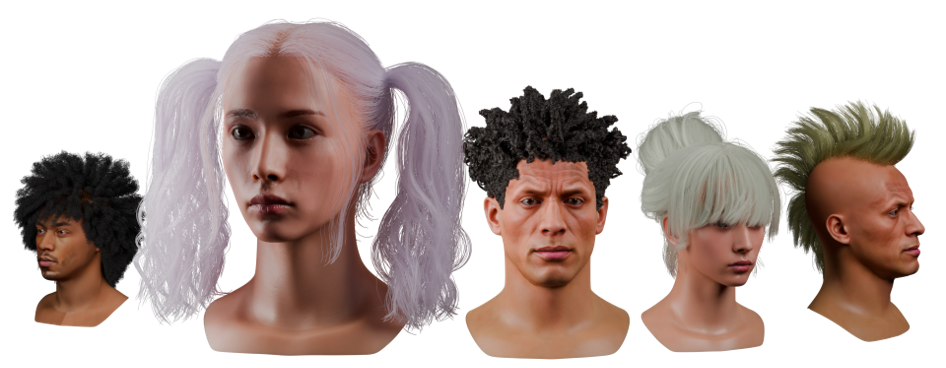
1. Strand-as-language modeling for hair generation
A paradigm shift to strand-as-language modeling, reformulating 3D realistic hair generation as a dual-decoupled autoregressive problem and treating strands as the core generative units.

Realistic hair generation remains difficult because hairstyles couple challenging global topology with high-frequency local detail. HairGPT addresses this problem with a strand-based generative pipeline that decomposes hair into a global density map and local strand geometry, then tokenizes both into a compact discrete representation. Generation proceeds over region-aware hierarchical sequences, allowing the model to predict structure and style progressively from text or image conditions. This design yields stronger control over topology, texture, and local edits, enabling high-fidelity synthesis of rare hairstyles as well as effective adaptation to stylized domains.
A paradigm shift to strand-as-language modeling, reformulating 3D realistic hair generation as a dual-decoupled autoregressive problem and treating strands as the core generative units.
A guide-strand tokenizer built with multi-head product quantization, compressing complex topology and high-frequency texture into a compact discrete codebook.
A hierarchical strand language with multi-stage training, organizing synthesis into region-aware sequences that improve structural coherence and make training more stable.
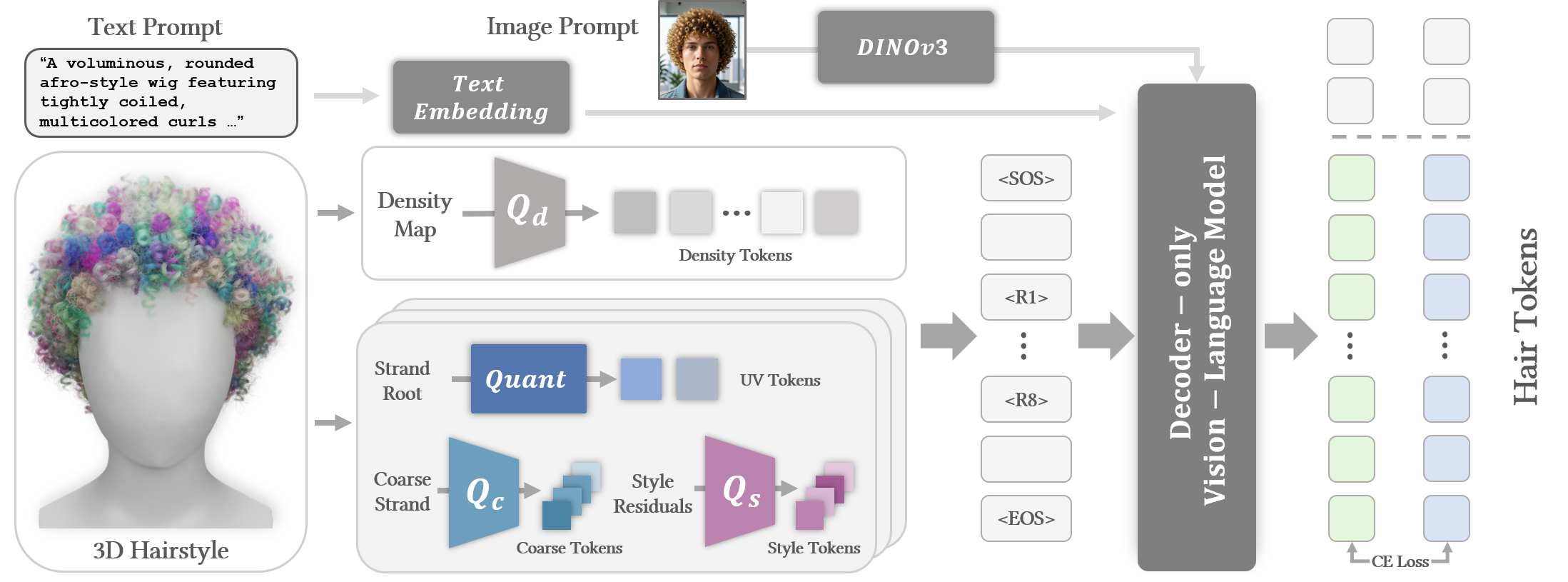
The 3D hairstyle geometry is decomposed into a global density map, quantized by tokenizer Qd, and local strand features. Specifically, strand roots are encoded into 2 UV tokens. The strand geometry is further decoupled into coarse shape and style residuals, which are discretized into 4 tokens via tokenizers Qc and Qs. These geometric codes are assembled into a hierarchical sequence and processed by a decoder-only Transformer. After being concatenated and conditioned on text and image embeddings, the model autoregressively predicts the target hair tokens and is supervised with a cross-entropy loss.
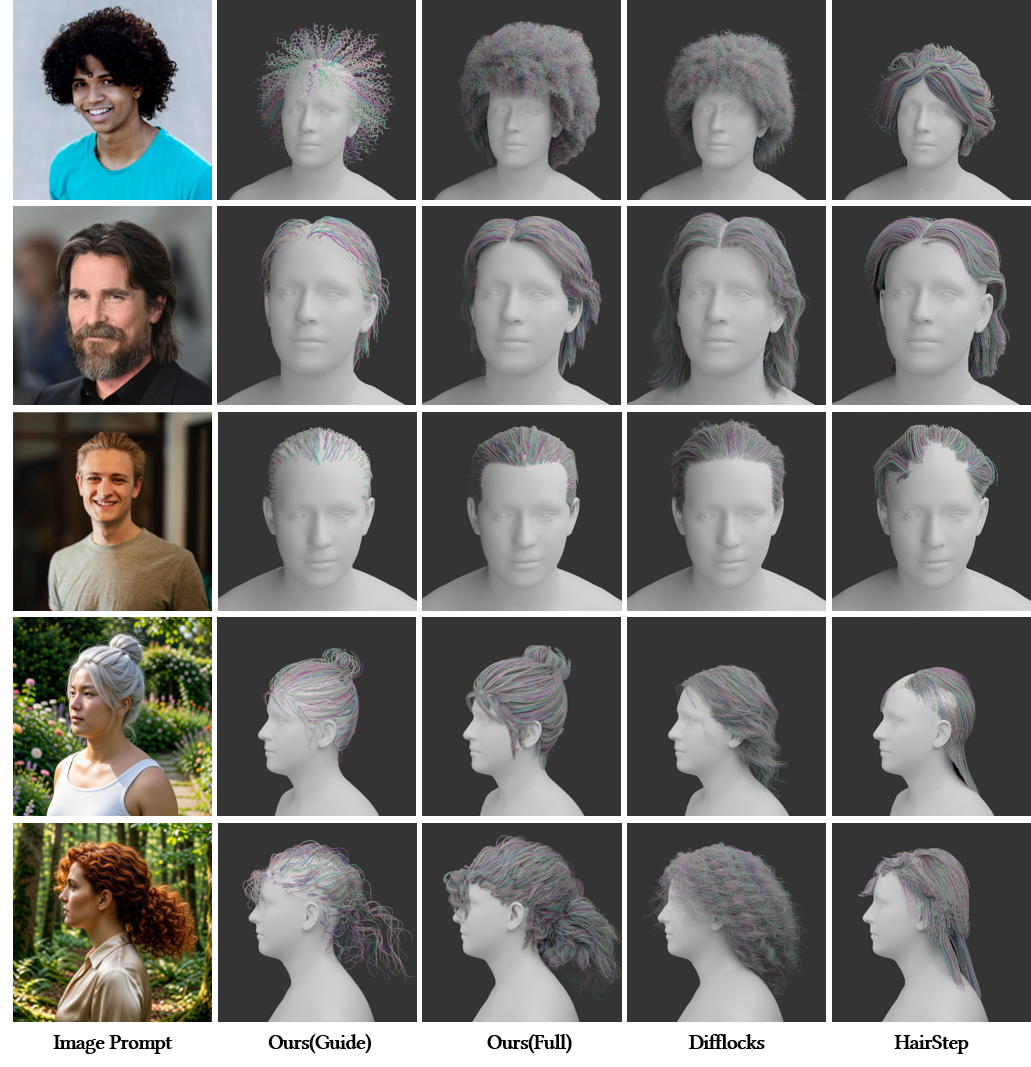
Image-guided hairstyle synthesis comparison. HairGPT can effectively generate extremely high-frequency coils and complex hair topology following the image, especially for buns and ponytails. We visualize both the raw guide strands directly output by our model and the dense strands produced via a simple interpolation algorithm; note that this upsampling process is employed solely for visualization and is not the primary focus of this work.
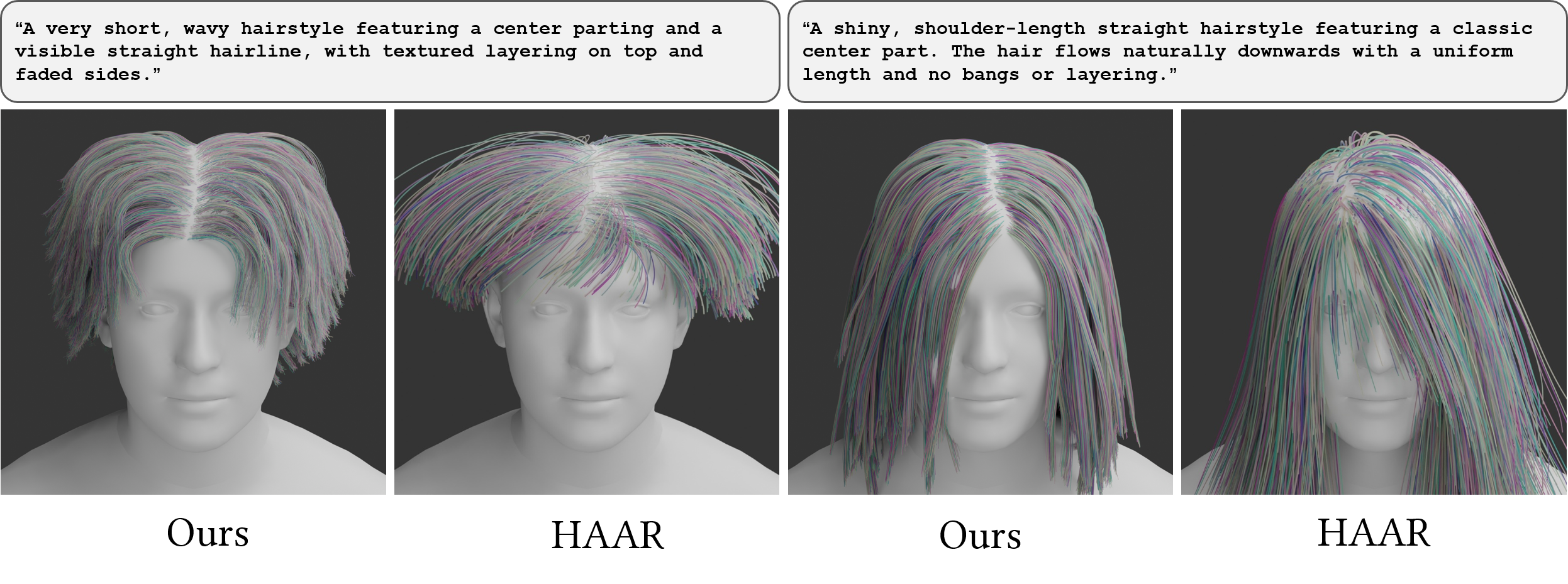
Text guided hairstyle synthesis comparison. Our HairGPT produces 3D hairstyles that adhere to fine-grained semantic instructions.
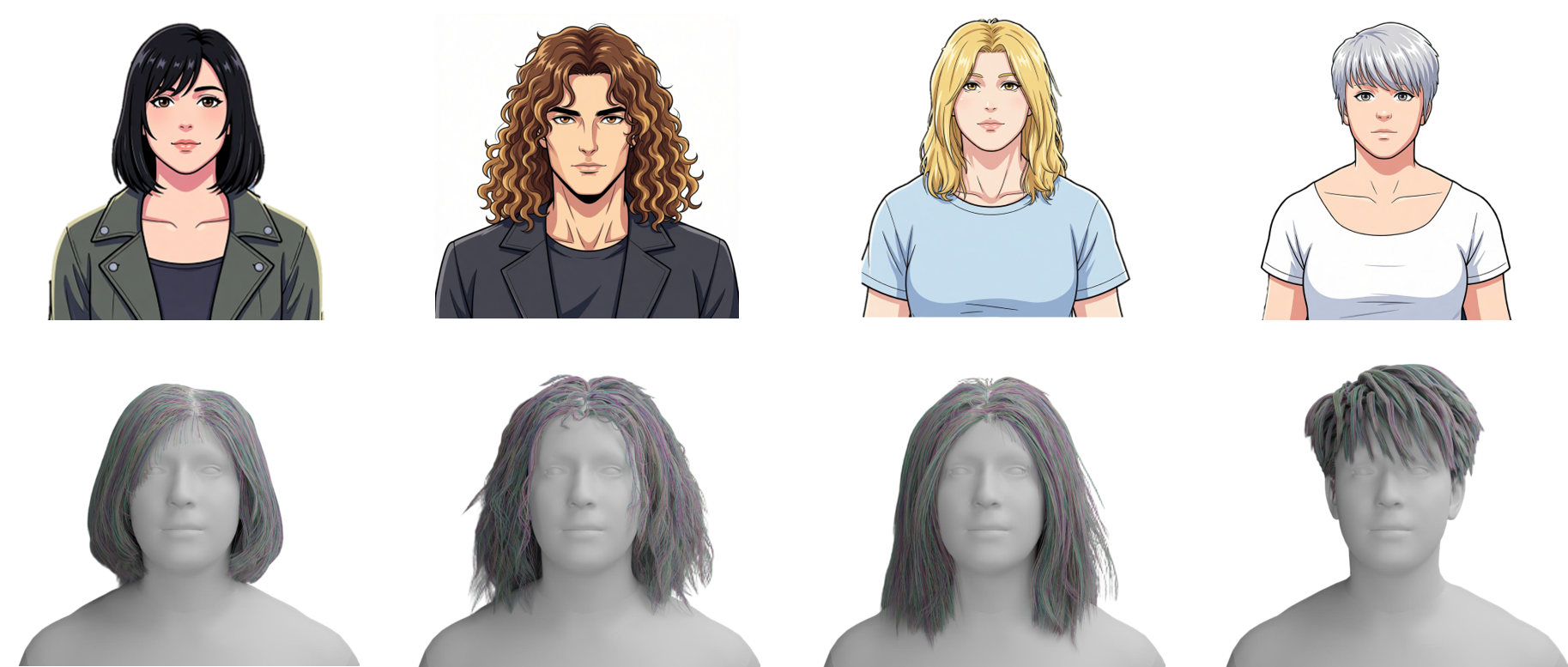
Cross-domain adaptation to stylized characters. Our framework adapts to 2D cartoon inputs via fine-tuning. It generates plausible 3D strand arrangements that faithfully respect the volume and flow of the original anime portraits.
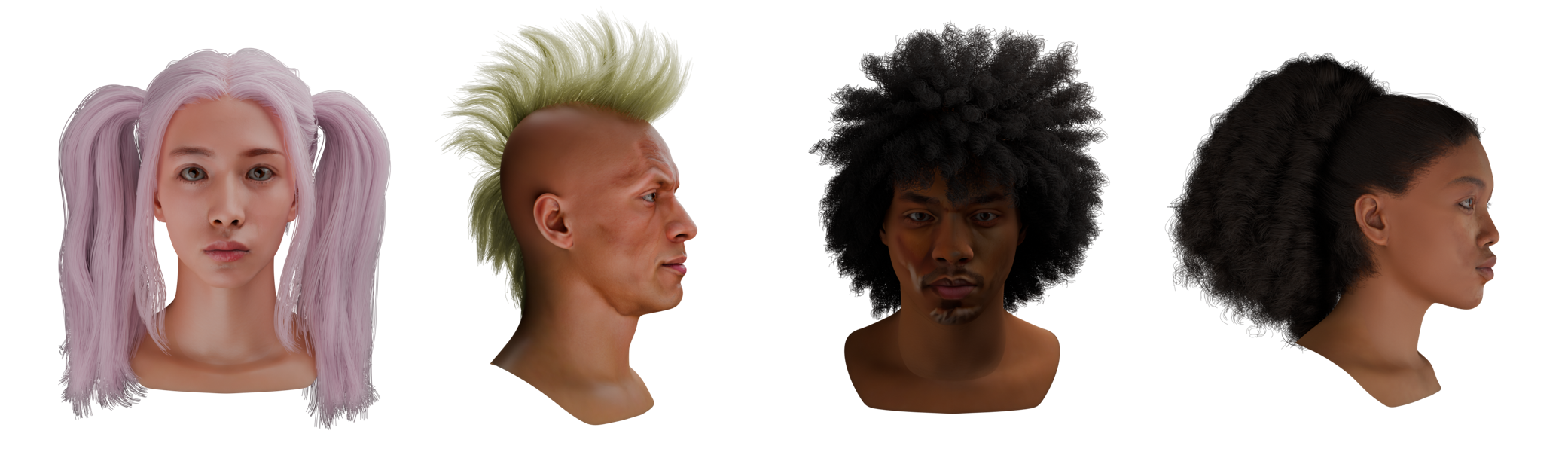
Realistic Avatar Creation. Our model can collaboratively work with the 3D face synthesis model DreamFace to produce photorealistic avatars with unified visual aesthetics.
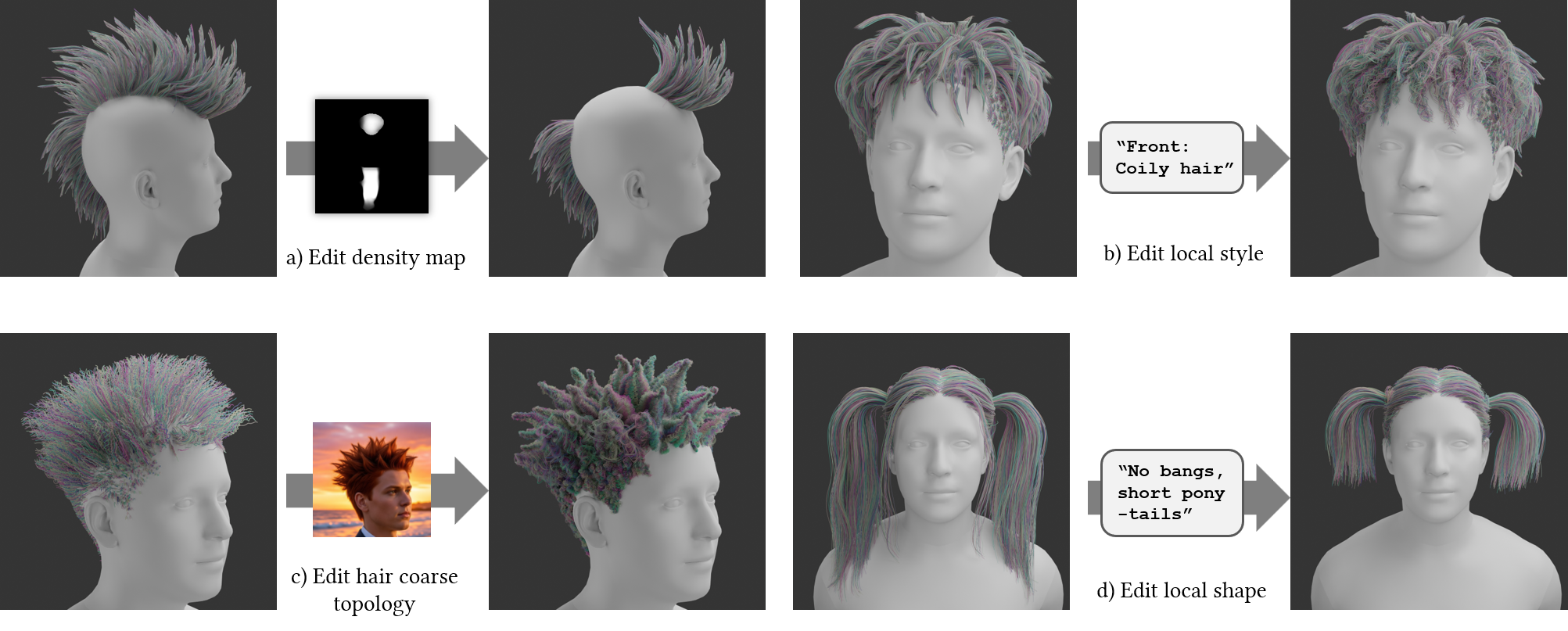
Editing. Our dual-decoupled representation and vision-language model naturally facilitates diverse editing applications, either image or text prompt.
This work was supported in part by the National Natural Science Foundation of China under Grant W2431046, Central Guided Local Science and Technology Foundation of China YDZX20253100001001, and by MoE Key Lab of Intelligent Perception and Human-Machine Collaboration (ShanghaiTech University), the Shanghai Frontiers Science Center of Human-centered Artificial Intelligence. This work was also supported by the HPC Platform of ShanghaiTech University.
The authors would also like to thank Heng'an Zhou from ShanghaiTech University for his assistance with the supplementary video, and Zijun Zhao from Deemos Technology Co., Ltd. for helping process part of the raw hairstyle data.
@article{10.1145/3811350,
        author = {Luo, Haimin and Ouyang, Min and Xu, Lan and Yu, Jingyi},
        title = {HairGPT: Strand-as-Language Autoregressive Modeling for Realistic 3D Hairstyle Synthesis},
        year = {2026},
        issue_date = {July 2026},
        publisher = {Association for Computing Machinery},
        address = {New York, NY, USA},
        volume = {45},
        number = {4},
        issn = {0730-0301},
        url = {https://doi.org/10.1145/3811350},
        doi = {10.1145/3811350},
        abstract = {Hair is a rich medium of visual and cultural expression, yet its digital modeling remains challenging due to the duality of fluidity and structure. Many existing generative approaches rely primarily on continuous diffusion fields, which entangle global topology with local texture and obscure the semantic and structural organization of hairstyles. To address this, we propose HairGPT, a strand-centric framework that treats strands as generative primitives and formulates realistic 3D hairstyle synthesis as a dual-decoupled autoregressive sequence modeling problem. Our method applies spatial decoupling across semantic scalp regions and structural decoupling along a hierarchical strand representation, progressing from global layout to fine-grained style. We further introduce a geometric tokenizer and region-aware semantic annotations to guide strand-level generation, enabling compositional editing, synthesis of rare and complex hairstyles, and adaptation to stylized domains. By aligning generative modeling with the workflow of digital grooming, HairGPT turns hair generation from opaque texture synthesis into a structured and semantically controllable authoring process, supporting robust semantic conditioning and high-fidelity results across realistic and stylized domains.},
        journal = {ACM Trans. Graph.},
        month = jul,
        articleno = {91},
        numpages = {14},
        keywords = {3D hair synthesis, hairstyle generation, strand-based representation, autoregressive modeling, geometric tokenization, multimodal generation, neural graphics}

}